
Use the symptom, not a guess, to choose the first repair step
The Fastener Problem Solver is designed for the moment when you know something has gone wrong but do not yet know which repair family fits. Start with the visible failure—broken fastener, damaged drive, seized joint or damaged threads—then add access and parent-material information. The result is a conservative starting path, not an instruction to jump straight to drilling or maximum torque.
How to use the result
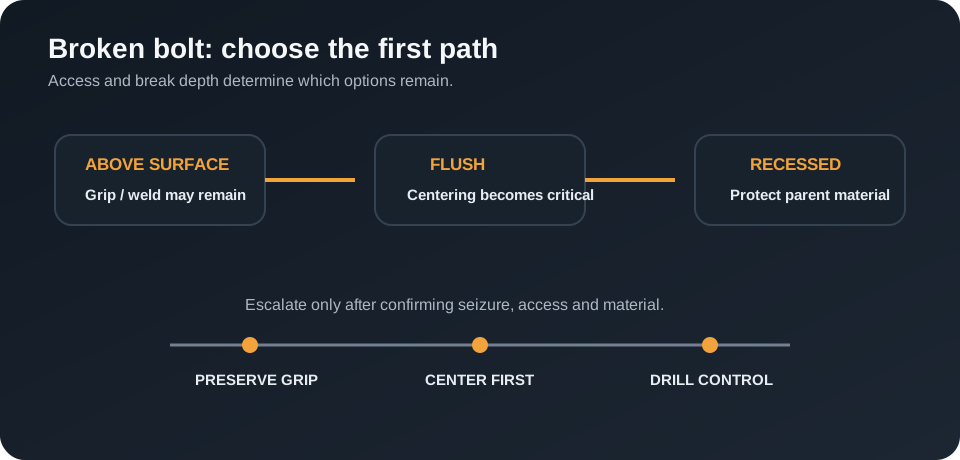
Read the suggested starting point as an escalation sequence. A broken fastener that still projects above the surface can often be approached differently from one recessed below the surface. A stripped drive on a free-moving screw is a grip problem; the same damaged drive on a corroded screw is both a grip and seizure problem. The tool deliberately keeps those conditions separate.
Before you escalate
- Confirm the correct drive or wrench size and clean the engagement surfaces.
- Identify whether corrosion, galling, cross-threading or thread damage is contributing to resistance.
- Protect the parent material and nearby sealing, bearing or finished surfaces.
- Stop if the fastener twists, the head deforms rapidly, a drill wanders or the component itself begins to move.
What the tool does not know
It does not know the manufacturer’s service limits, fastener grade, hidden component geometry, heat sensitivity or whether a joint is safety-critical. Brake, steering, suspension, lifting, pressure-containing and similarly critical joints should be repaired according to the equipment maker’s approved procedure or inspected by a qualified professional.
Examples
Broken bolt below the surface in aluminum: centering and protection of the soft parent material become the first priorities. Stripped Torx head with the screw still free: restore grip before considering extraction. Stainless fastener that tightens abruptly during removal: consider galling rather than treating the resistance as ordinary rust.
Related FastenerBench guides
Use the result to continue into the matching Broken Bolts, Stripped Screws, Damaged Threads or Stuck Fasteners hub. Those guides explain the method choices, failure signs and stop conditions in more detail.